
Quick answer: The quote-to-cash pipeline leaks at four predictable joints: quotes sent and never answered (follow up in 2–3 days with something added, not "just checking in"), quotes accepted but never invoiced (convert the same day — this stall is yours), invoices sent but unpaid (configure the reminder ladder once), and the silent no (close it gracefully and recycle to nurture). Track acceptance so you know opened from ignored, and read the receivables numbers monthly — each stall has its own metric and its own fix.
There's a number hiding in every service business: the value of work that was quoted, wanted, sometimes even accepted — and never became money. Not lost to competitors. Lost to silence, delay, and follow-ups that never got sent. It's routinely the easiest revenue in the business to recover, because the hard part — a customer who asked for a price — already happened.
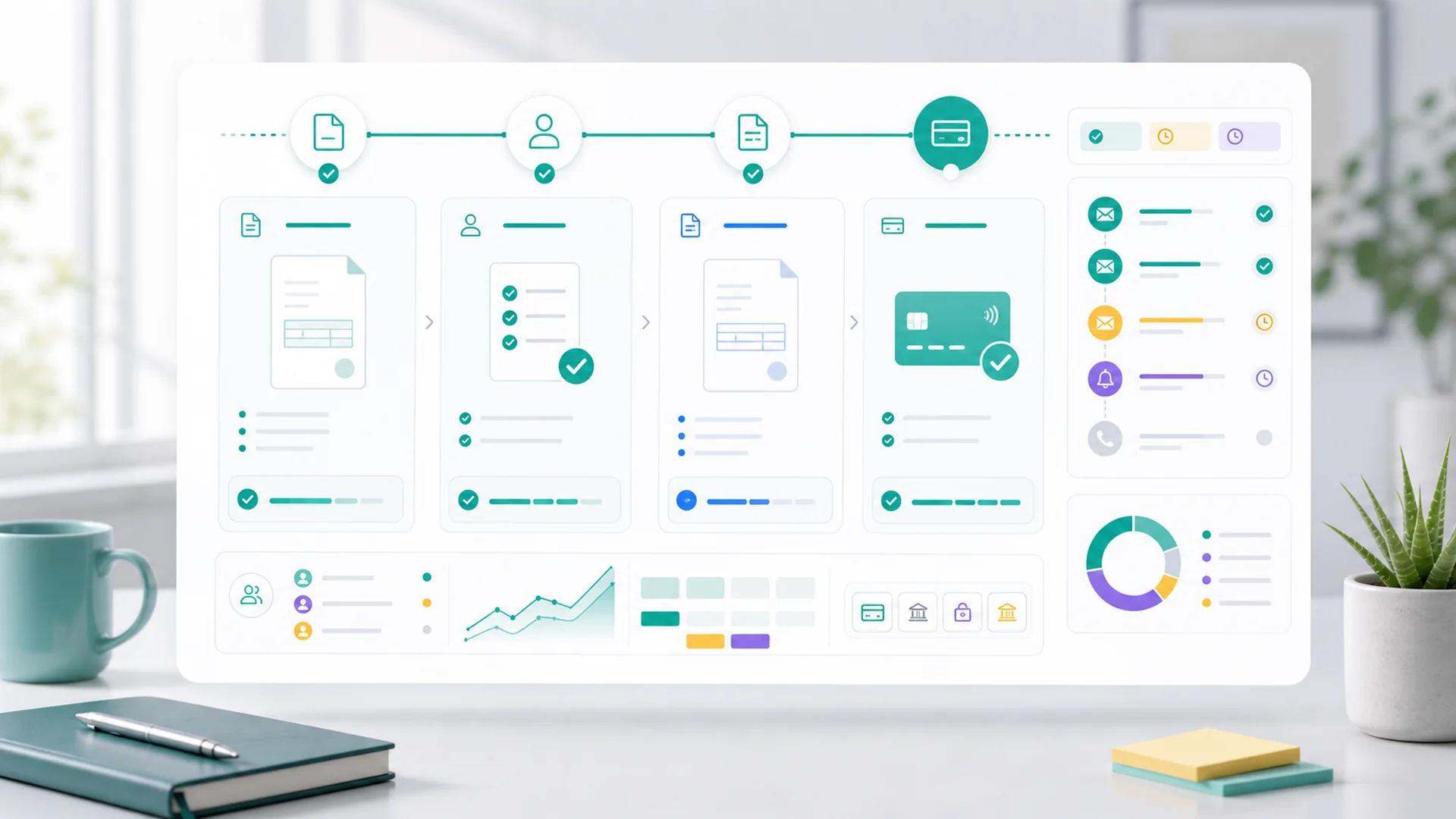
The fix is a playbook, not hustle. A quote moves through four states — sent, accepted, invoiced, paid — and it stalls at each joint for a different reason, with a different remedy. Here's each stall, and the system that unsticks it.
First, make the pipeline visible
You can't fix stalls you can't see. The prerequisite is running quotes as quotes — created with clear line items and terms, sent through the system rather than as a PDF attachment lost to an inbox — so that acceptance tracking can tell you the one thing email never will: was it opened and ignored, or never really seen? Those are different conversations, and guessing wrong makes you either a pest or a pushover.
(AI can draft the quote structure from the job notes — line items, terms, the works — with the usual review gate before anything customer-facing sends. The pricing inside it is your judgment, per the pricing playbook.)
The four stalls
Most quote silence isn't rejection; it's life. The follow-up that works arrives two to three business days after sending, and it adds something instead of asking for something: an answer to the question they probably have ("the timeline includes materials delivery"), an option ("if budget's the issue, here's the phased version"), a relevant photo of similar finished work. "Just checking in" asks them to do the work; an addition does the work for them.
If tracking shows the quote was opened repeatedly but unanswered, price is usually the snag — that's the moment to revise the quote with a phased or trimmed option rather than wait for a no. One follow-up at day 3, one at day 10, then stall 4.
The embarrassing one: the customer said yes and the invoice went out... eventually. Every day between acceptance and invoice costs twice — the payment clock hasn't started, and the customer's enthusiasm is quietly cooling. The remedy is mechanical: convert the accepted quote to an invoice the same day, which carries the approved line items and history straight into billing instead of recreating them by hand (re-typing is where both delay and discrepancies are born — an invoice that doesn't match the quote is a dispute you scheduled).
Acceptance should trigger conversion the way a form fill triggers a journey: automatically expected, never remembered into existence.
Unpaid invoices are mostly unawkward problems handled awkwardly. Nobody enjoys chasing money, so configure the chase once and let it run: payment reminders as a polite escalation ladder — a friendly note as the due date approaches, a clear one when it passes, a firmer one after — written in your voice on the day you felt reasonable, sent on the day you'd have felt squeamish.
Pair the ladder with low payment friction: an invoice with a pay-now path gets settled the moment it's opened; an invoice that requires a bank transfer ceremony waits for a someday that's always next week. Due dates mean something when the system, not your memory, enforces them.
After two follow-ups and a few weeks, silence is an answer. Send the close-out: "I'll assume the timing isn't right — no hard feelings, the quote stands until [date] if things change." It reads as confidence, occasionally revives the deal on the spot, and frees your pipeline from zombie quotes that make every report a lie.
Then recycle, don't discard: the not-now prospect joins your nurture list — the newsletter, the seasonal campaign — where this year's no becomes next year's "actually, is that quote still good?" The record of the whole exchange stays on their customer timeline, so when they return, you're not starting from zero.
Read the pipeline monthly: three numbers, three diagnoses
The receivables analytics turn the playbook into a feedback loop. Once a month, three numbers:
- Acceptance rate diagnoses your quotes — chronically low means pricing, presentation, or qualifying the wrong jobs. (Watch it by job type: a 30% acceptance on kitchen remodels and 80% on repairs is telling you something about where to aim.)
- Time from acceptance to invoice diagnoses your operations — this one should be hours, and it's entirely within your control.
- Days to paid diagnoses your collection — if it drifts up, the reminder ladder or the payment friction needs attention, and the per-customer money view shows whether it's everyone or three habitual late-payers who deserve deposit terms.
One number, one fix, per month — the same discipline as the weekly website ritual, pointed at the part of the funnel where the money already said yes.
Key takeaways
- Make the pipeline visible: run quotes through the system so acceptance tracking distinguishes opened-and-ignored from never-seen.
- Follow up at day 3 with an addition, not a check-in: repeatedly-opened-but-silent means revise with an option.
- Convert accepted quotes the same day: the acceptance-to-invoice gap is the stall that's entirely yours.
- Automate the chase: configure the reminder ladder once, in your voice, and pair it with a pay-now path.
- Close silent quotes gracefully and recycle prospects to nurture: zombie quotes poison every report.
- Three monthly numbers: acceptance rate (your quotes), time-to-invoice (your ops), days-to-paid (your collection).
Frequently asked questions
How many follow-ups before I'm being annoying?
Two genuine follow-ups (day 3 and around day 10) plus one graceful close-out is the full sequence. Annoying isn't a count — it's repetition without addition. Three messages that each bring something new read as attentive; three "just checking in"s read as pressure.
Should quotes expire?
Yes — 30 days is standard and it's not a gimmick: materials and schedules genuinely change, and an honest expiry gives your follow-ups a real deadline and your close-out a natural hook. Re-quoting after expiry also lets you correct a price that was part of the problem.
Do payment reminders damage customer relationships?
The opposite, when they're systematic: customers experience consistent, polite reminders as professionalism, and ad-hoc chasing — which arrives late, irritated, and personal — as the relationship damage. The ladder protects the relationship by removing the resentment buildup before it starts.
When should I ask for a deposit instead of invoicing after?
When the job has real prep costs, when no-shows or cancellations are expensive, or when a specific customer's days-to-paid history has earned it. A deposit converts stall 3 from a collection problem into a scheduling step — and customers who balk at a reasonable deposit are usually previewing how they'd have paid the invoice.
My acceptance rate is fine but everything pays late. Where do I look?
Stall 3 specifically: check days-to-paid per customer to separate a friction problem (everyone slow → add pay-now, tighten the ladder) from a client-mix problem (three accounts dragging the average → deposits or terms for them). The per-customer money view answers it in five minutes.
Quotes, acceptance tracking, conversion, invoices, reminders, and the receivables numbers all live in one Faster workspace — the playbook is mostly configuration you do once. Set the reminder ladder tonight, convert yesterday's acceptance this morning, and go collect the easiest revenue you have.