
Quick answer: Win back lapsed customers with a three-email journey triggered by your own definition of "lapsed": a human we-noticed note with no discount, a what's-changed email carrying the sequence's one modest incentive, and a final the-door-stays-open message with a stay-in-touch option. Trigger it from a segment that fills itself, exit anyone who engages, never send it over an unresolved complaint — and judge it by reactivations, not opens.
A lapsed customer is the cheapest customer you will ever acquire. They already know where you are, what you charge, and what it's like to work with you — the trust that costs strangers months is just sitting there, dormant. And yet most small businesses spend their marketing chasing new names while a list of people who already said yes once drifts quietly away.
The win-back is the highest-leverage email sequence in the toolkit, and it's three messages long. Here's the version that runs itself — triggers, copy, exits, and the honest numbers to expect.
First: define "lapsed" by your rhythm, not a rule of thumb
Lapsed means overdue by your business's natural cycle — and every business has one. A salon's regulars return every five to eight weeks, so twelve silent weeks is lapsed; an accountant's clients appear annually, so lapsed starts around month fifteen. Look at your repeat customers' actual spacing — your customer timelines hold the answer — and set the threshold a comfortable stretch past normal.
Then make the definition operational: a saved view or segment — "last booking more than 12 weeks ago, was previously a repeat customer" — that fills itself as customers cross the line. That self-filling segment is the trigger for everything below; no monthly spreadsheet exports, no manually noticing. (The segment logic is the same craft as send less, sell more — this is just its highest-ROI segment.)
One guard before anyone enters the sequence, borrowed from the referral playbook: check the record first. A customer whose activity shows an unresolved complaint doesn't get a cheery win-back — they get a human resolving the complaint. Automating warmth over an open wound is how win-backs become Yelp reviews.
The three emails
A short note from a person: it's been a while, here's the one or two things that are new since you visited (the Saturday hours, the new service, the renovated room), and one easy way back in — the booking link, nothing else.
No discount. Leading with one teaches that leaving earns coupons — and a meaningful share of lapsed customers just… drifted. Life got busy. For them, a warm nudge is the entire fix, and you keep your margin and your dignity. This email alone typically produces a third of the sequence's returns.
Address the likely friction directly — price, scheduling, forgetting — and carry the sequence's one incentive: modest, framed as a welcome-back rather than an apology ("your next visit's on us for 20% — we'd love to see you before the end of the month"). A real deadline, weeks not days.
The honest pricing rules from the campaign playbook apply: a true discount, a kept deadline, once. This is the only message in the sequence where money talks.
Short, warm, and explicitly final: no hard feelings, here's where to find us if the timing's ever right — and a genuine choice: stay on the newsletter only, or step away entirely. The downgrade option keeps a slice of the relationship that total-unsubscribe would burn, and the people who do leave were never coming back; their exit is deliverability medicine, not loss.
The self-respect matters commercially: a sequence that visibly knows when to stop reads completely differently from one that will clearly never stop. This email converts surprisingly well precisely because it isn't trying to.
Wire it as a journey, not a campaign
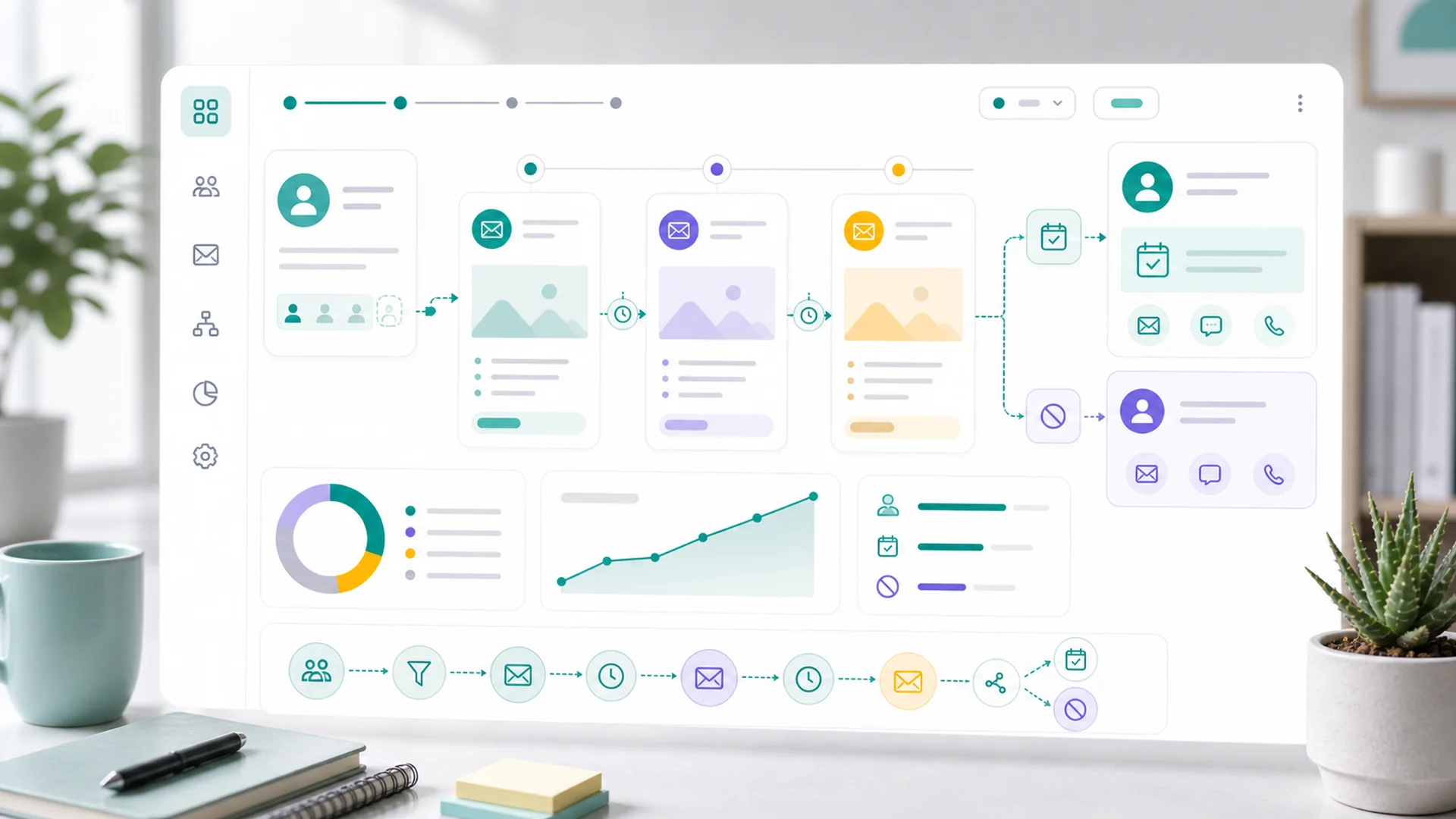
A win-back run as a quarterly blast hits everyone at the wrong moment; built as a customer journey, each person enters the day they cross your lapsed line and gets the sequence timed to their own drift:
- Entry: joins the lapsed segment (and passes the no-open-complaints guard).
- Exit on any sign of life — immediately. A booking, a purchase, even a reply pulls them out of the sequence. Nothing reads worse than "we miss you!" arriving the day after they came back. Exits are where journey design earns its keep.
- Pace for the season: pause the journey during your December crush or August closure rather than letting automated warmth land in chaos.
Measure it like it costs money (because silence does)
The win-back has the cleanest goal in email marketing: did they come back? Define it before launch — a booking or purchase within 60 days of entering the journey — and read the journey report against it monthly:
- Reactivation rate is the number. For most small businesses, 5–15% of entrants returning within the window is a healthy, honest result — and at near-zero cost per send, it's routinely the best ROI email you run. Opens and clicks are diagnostics, not the goal.
- Read failures by stage. Nobody opening email 1 → subject line or sender name. Opens but no returns after email 2 → the friction you guessed isn't the real one — and the replies you get are free research naming the real one.
- Count the cleanup as a win. The unsubscribes and stay-on-newsletter downgrades from email 3 leave you a more engaged list with better inbox placement — the sequence pays even on the people it doesn't recover.
Key takeaways
- Define lapsed by your rhythm: your own repeat cycle sets the line, and a self-filling segment is the trigger.
- Guard the entrance: unresolved complaints get a human, never an automated we-miss-you.
- Email 1 is human with no discount: email 2 carries the one modest, deadlined incentive; email 3 is explicitly final with a newsletter-only downgrade.
- Run it as a journey with exit-on-any-engagement: never sell at someone who already came back.
- Judge by reactivation rate against a defined window: 5–15% is honest success at near-zero cost.
- The unsubscribes are a win too: a cleaner list delivers better forever.
Frequently asked questions
Why not lead with the discount? It's the strongest card.
Because a meaningful share of lapsed customers don't need it — they drifted, and a warm note brings them back at full price. Leading with money trains the rest to lapse on purpose next time. Play the strongest card second, to the people the free move didn't reach.
What if someone lapses again after being won back?
They re-enter the journey when they re-cross the line — that's the self-filling segment working. But add a once-per-year cap per customer: a third win-back in twelve months isn't persistence, it's a relationship telling you its real frequency. Respect it and let the newsletter carry them.
Should service businesses call instead of email?
For your highest-value lapsed clients, yes — a personal call or text beats any sequence, and the segment view tells you exactly who's worth one. Run the journey for the broad middle and a task list for the top ten; it's the same personal-tier/scaled-tier split as referrals.
How do I write these without sounding desperate?
State facts, make one offer, accept the outcome — desperation is mostly length and repetition. Three short emails that each say one thing, with a visible end, read as confidence. AI can draft them in your voice from this structure; the usual review gate applies since they're customer-facing.
What's a realistic timeline to see results?
The first entrants finish the sequence in about a month, and the 60-day measurement window means real numbers land around month two or three. Resist judging it on week one — the win-back is a system you install, not a campaign you watch.
The segment, the journey, the guard, and the report all live in one Faster workspace — an afternoon to build, then it works your quietest list forever. Define your lapsed line today; the cheapest customers you'll ever acquire are already on it.