
Quick answer: Market your course before you record it: publish a one-page promise with a waitlist form, nurture that waitlist with a short email sequence that teaches something real, run a free live webinar as the launch event, and open enrollment with a genuine deadline. If the waitlist stays empty, you've learned the promise needs work — for the cost of one page instead of two months of recording.
The saddest object in online business is a finished course nobody bought. Months of outlining, recording, and editing — launched to an audience that was never asked whether they wanted it. The reviews aren't bad; there simply aren't any.
The fix is to invert the order. We've covered how to build and publish the course itself — this post is about everything that should happen before the record button: the waitlist, the emails, the launch webinar, and the moment you learn whether this course deserves to exist.
Sell the promise first — recording comes after the evidence
Pre-selling sounds aggressive until you see what it actually is: asking your audience the question "would you want this?" in a form they can answer honestly. A waitlist signup costs your audience nothing, and the count is real evidence — far better evidence than likes on a "thinking of making a course!" post, because joining a waitlist is a small act of intent.
The math is the argument. Recording a course takes weeks; a promise page takes an afternoon. If 60 people join the waitlist, record with confidence. If 4 do, the promise — the outcome, the audience, or the framing — needs revision, and you found out for the price of one page. Either result is a win; only the order of operations decides whether the lesson costs you an afternoon or a season.
The promise page: one page, one form
You don't need a sales site. You need one page that says, in your customer's words: what you'll be able to do after this course, who it's for, and roughly when it opens — and a two-field waitlist form. Pull the page copy straight from your course outline's one-sentence promise and outcome list; if the outline can't produce a compelling page, that's the validation working early.
Keep the waitlist form minimal — name and email, nothing else. Every extra field costs signups, and a waitlist's only job is permission to keep talking (we covered the field-cost math in lead capture forms that convert). Then connect the form to an audience and journey, so every signup lands in a dedicated course-waitlist segment and the follow-up starts automatically — no spreadsheet, no copy-paste.
Nurture the waitlist by teaching in public
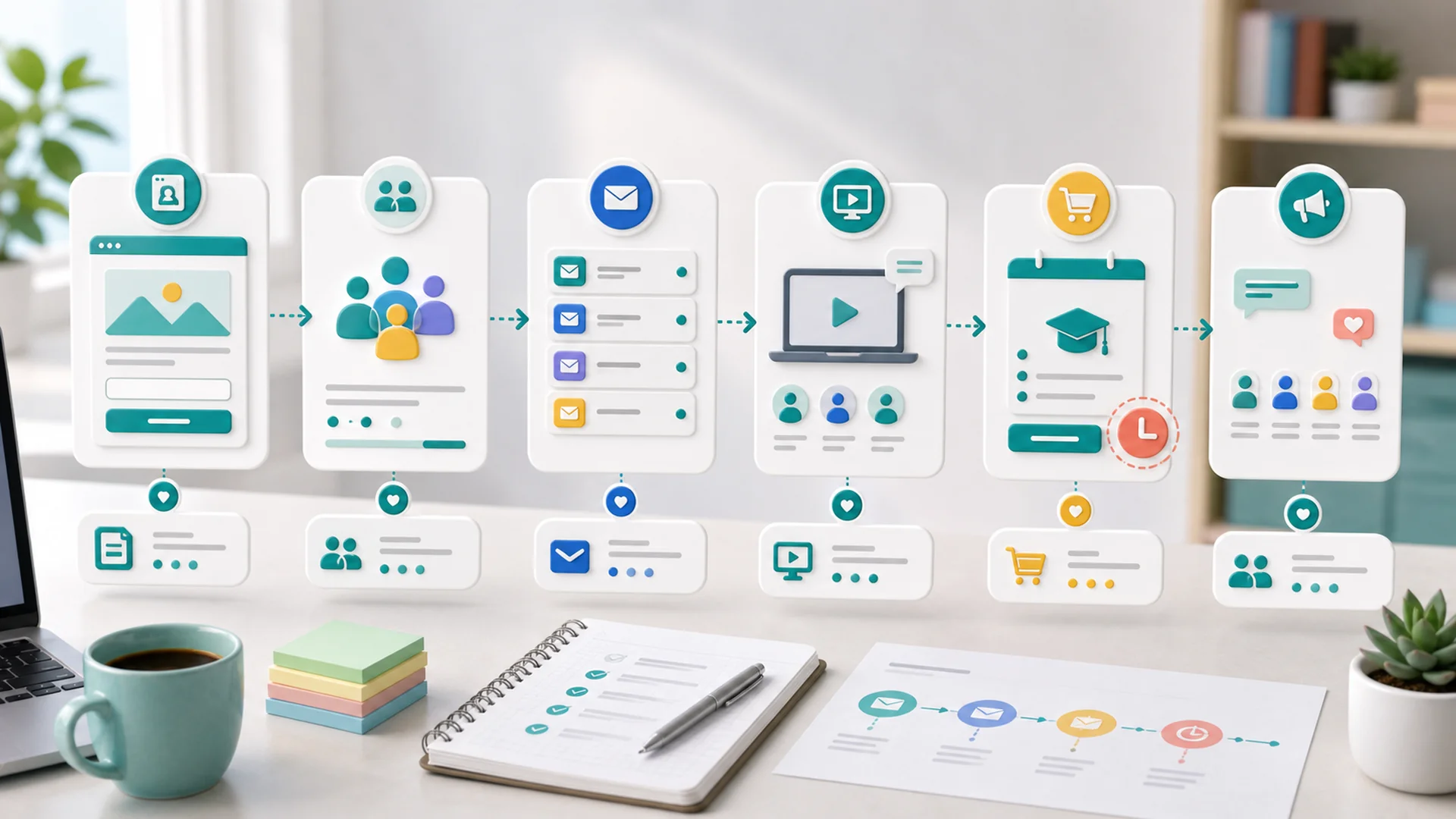
A silent waitlist goes cold; weekly "almost ready!" updates go ignored. The sequence that works does neither — it teaches. Each email delivers one genuinely useful lesson from the course's territory, proving you can teach before asking anyone to pay for it. Three or four emails over the pre-launch weeks is plenty:
Confirm what they joined, tell the story of why this course exists (the mistake you kept seeing, the question you kept answering), and set expectations for what's coming.
Take a small, complete piece of the course and give it away — the checklist, the first exercise, the myth debunked. The reader should finish each email having gained something even if they never buy.
Announce the live class: what you'll teach, when, and that course enrollment opens there first — with founding-member pricing for attendees.
This is a standard welcome-journey build in your workspace — same mechanics as the welcome sequences playbook, and the same craft rules from the email marketing guide: one idea per email, subject lines that say what's inside, sent from a person.
The webinar is your launch event
A free live class is the highest-trust marketing a course creator can do, because it is the product — sixty minutes of you teaching is a free sample of exactly what buyers are buying. Create the webinar around one meaty lesson from the course (not a content-free teaser), open registration to your waitlist first, and let automatic reminders protect your show-up rate — registrations without reminders evaporate.
Structure the hour honestly: teach for forty minutes, answer questions, and then make the offer plainly — here's the course, here's what's in it, here's the founding price for people in this room. Afterward, share the replay with everyone who registered but didn't attend; for most launches the replay-watchers match or outnumber the live room. The full funnel mechanics — registration page, reminders, replay economics — are in webinars that sell.
Open the doors with a real deadline
Enrollment that's always open is enrollment that's always postponable. Launch with a window — a week is typical — and a reason to act inside it: founding-member pricing, a live Q&A cohort, direct access to you during the first run. Then close it or end the founding price on schedule, visibly. A deadline kept this launch is what makes your next launch's deadline mean something. Run the window as a proper launch campaign — announce at the webinar, follow with two or three emails (open, mid-window proof, final day), and let the journey do the sending.
Founding-member pricing deserves its name: these buyers are funding the course's creation and taking it before reviews exist. Price the discount accordingly, and ask founding members for the two things money can't buy — honest feedback while you record, and testimonials for the public launch. (For the underlying price itself, the pricing-with-confidence framework applies to courses unchanged: price the outcome, not the video minutes.)
Read the numbers before you press record
The pre-launch produces three numbers, and each one tells you something different:
- Waitlist size measures the promise. Small list from decent traffic → the outcome or audience framing is off. Revise the page before anything else.
- Webinar show rate measures the relationship. Big list, empty room → your emails aren't building anticipation; more teaching, less announcing.
- Founding conversion measures the offer. Full room, few buyers → usually a price-to-promise mismatch or a mushy close. Sharpen the offer, not the slides.
There's no universal pass mark, but the order of repair is fixed: promise, then relationship, then offer. And when the numbers do clear your bar — record the course for an audience that has already paid to receive it. That's the version of course creation where every hour of production has a buyer waiting at the end of it.
Key takeaways
- Market before you make: a waitlist is validation evidence that costs an afternoon instead of a season.
- The promise page needs one outcome, one audience, one two-field form: pulled straight from your course outline.
- Nurture the waitlist by teaching: three or four emails that each deliver a real lesson, then the invitation.
- The launch webinar is a free sample of the product itself: teach honestly, offer plainly, send the replay.
- Launch with a window: open enrollment with a deadline you visibly keep, and treat founding members as co-creators, not discount hunters.
- Diagnose in order: waitlist size = promise, show rate = relationship, conversion = offer.
Frequently asked questions
Isn't it dishonest to sell a course that doesn't exist yet?
Not if you say so. Founding-member enrollment is explicit: the course releases on a stated schedule, buyers get the founding price and direct input, and you refund without argument if you miss the commitment. That's a pre-order, and audiences understand pre-orders.
How big does my audience need to be before trying this?
Smaller than you think, but not zero. A few hundred engaged email subscribers or social followers is enough to read the signal. With no audience at all, the waitlist will be silent for reasons that have nothing to do with the course — build the audience first, which the teaching emails conveniently start doing.
How long should the pre-launch run?
Three to six weeks from promise page to enrollment close. Shorter and the waitlist hasn't warmed; longer and anticipation decays into forgetting. The email cadence — roughly weekly — sets the natural length.
What if people join the waitlist but nobody buys?
Then the diagnosis order says: promise was fine, so look at the relationship and the offer. Most often the price-to-promise link wasn't made — buyers never heard what the outcome is worth in their terms. Survey the waitlist, fix the offer, and run one more webinar before abandoning the course.
Do I really need a webinar? I hate being live.
The live event converts best because it's the most honest sample, but the structure matters more than the format. A recorded workshop premiered at a set time, with you live in the chat, keeps the deadline and most of the trust while staying off camera-pressure.
Should I record the course while the pre-launch runs?
Outline fully, record nothing final. The pre-launch will change the course — waitlist replies and webinar questions tell you which modules matter and what language buyers use. Record after enrollment closes, while founding members wait happily for a course shaped by their own questions.
The whole pre-launch — promise page, waitlist form, email journey, webinar, and launch campaign — runs in one Faster workspace, wired together instead of duct-taped across five tools. Put up the promise this week; let the waitlist tell you what to record.