
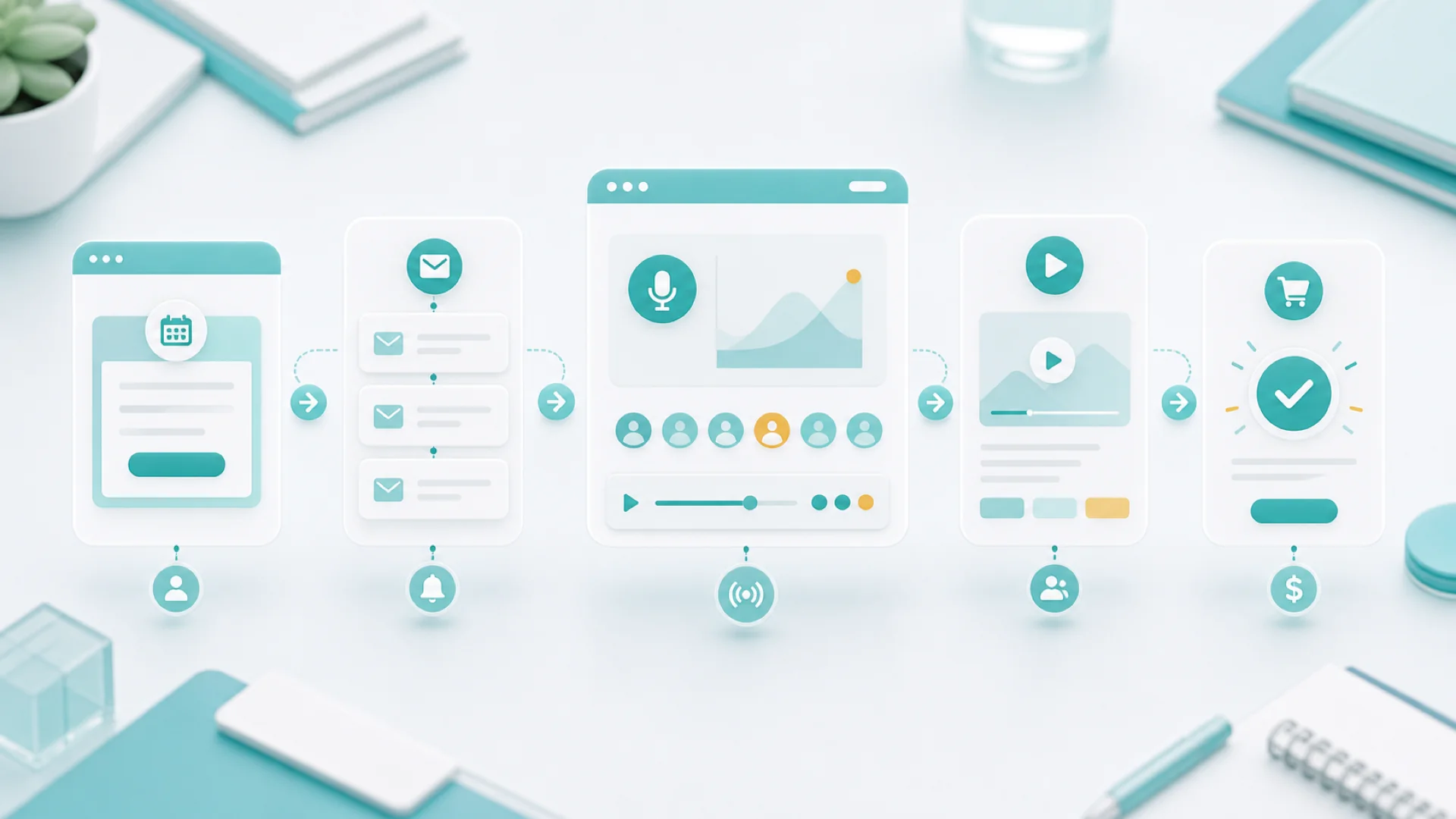
A webinar that sells is a five-stage funnel: a promise worth an hour of someone's life, a registration page that converts interest into a calendar slot, a reminder ladder that beats the no-show problem, a live hour that listens as much as it presents, and a replay sequence — where as many sales close as on the day itself.
Webinars have a reputation problem: everyone's attended a bad one, so everyone assumes running one is either easy (it isn't) or pointless (it isn't). For service businesses, course creators, and consultants they remain the highest-trust selling format that scales — an hour of you being visibly competent in front of fifty prospects at once. The catch: the webinar itself is maybe a third of the work. The funnel around it is the rest.
A promise worth an hour
People don't register for topics; they register for outcomes they can picture. "Social media marketing tips" earns a shrug. "Plan 30 days of content in 90 minutes — leave with your calendar done" earns a registration, because it promises a specific, finished thing. The test for your title: could an attendee know, the moment it ends, whether you kept the promise? If yes, it's specific enough. Pick a promise adjacent to what you sell — the webinar should be a free sample of the thinking people then pay you to apply.
A registration page with one job
Set up the webinar with a registration page that follows lead-form rules: the promise as the headline, three bullet outcomes, the date and time with timezone, who's presenting and why they're credible — and a form asking for name and email, nothing else. One extra field worth considering: "what's your biggest question about [topic]?" — optional, and it writes your content outline for you. If you run recurring sessions, schedule them so registrants pick a time instead of waiting for your next announcement.
The reminder ladder
Here's the math nobody likes: without reminders, roughly a third of registrants attend. The gap isn't disinterest — it's that life happened between registration and Tuesday at 2pm. Reminders are part of the webinar experience, not marketing noise, and they follow a ladder:
Test every message before launch by registering yourself — the schedule, timezone, and join-link behavior should be checked from an attendee's seat, not the dashboard.
The live hour listens
Format that works: deliver the promise in 35–40 minutes, answer questions for 15, and make one clear offer at the end — said plainly, once, without the twenty-minute pitch crescendo that poisoned the format's reputation. While you present, the chat and questions are doing something underrated: they're a transcript of your market's objections and confusions, in their own words. Review them after — they're next quarter's content calendar and this quarter's sales follow-up context, attendee by attendee.
The webinar ends at the hour mark. The selling mostly happens after.
Registrations, attendance, questions, and replay views are all follow-up signals — if you use them.
The replay is half the funnel
Two-thirds didn't attend live — and they registered, which makes them warm, not lost. Share the replay within 24 hours while the promise is still fresh, with honest scarcity if you mean it ("available through Friday"). Then segment the follow-up using registration and attendance data: attendees get the offer recap and a direct next step; no-shows get the replay and one more chance; the people who asked buying-signal questions get a personal email, because they raised their hand in public. That last group converts at rates that make the whole webinar worth it.
Free or paid registration
Free maximizes reach and suits webinars that sell something afterward — the webinar is marketing. Paid registration suits workshops where the session itself is the product: even a modest price transforms attendance (people show up for what they paid for) and filters for seriousness. The mechanics matter — clear price, payment at registration, access only on completed payment, refund terms stated — so the attendee record stays clean if someone cancels. A good rule: free when you're selling after, paid when the hour is the value.
Key takeaways
- Promise an outcome, not a topic — attendees should know if you kept it.
- Registration asks for name and email — plus one optional question that writes your outline.
- The reminder ladder beats the no-show math: confirmation, day-before, hour-before, live-now.
- Deliver 40, answer 15, offer once — and read the chat as market research.
- The replay sequence is half the revenue: 24-hour share, segmented follow-up, personal notes to question-askers.
Frequently asked questions
How many registrants do I need for it to be worth it?
Twenty registrants is a real webinar — expect 6–8 live, and remember the replay audience doubles it. For a service business, one client from that group pays for the effort many times over. Small and consistent beats big and annual.
What if almost nobody shows up live?
Run it anyway, at full quality — the recording is the asset, and the replay sequence doesn't know how many chairs were filled. Low live turnout usually traces to a weak reminder ladder or a topic-shaped (not outcome-shaped) promise; fix those before concluding webinars don't work for you.
How often should I run one?
Monthly is the sweet spot for most small businesses: frequent enough to compound (each one improves the last one's material), rare enough to prepare properly. Reuse the structure — same funnel, refreshed promise — so each webinar costs half the setup of the previous.
Should the replay stay up forever?
Time-boxed replays (a week or two) convert better and keep your material current — an evergreen replay of last year's webinar quietly ages your expertise in public. Exception: turn your best session into a polished evergreen asset deliberately, as its own project with its own registration form.
Can the follow-up emails be automated?
Almost all of it — confirmation, the ladder, replay delivery, and the attended/no-show branches run as a journey wired to registration, exactly like the welcome sequences. The one thing to keep manual: the personal note to people whose questions signaled buying intent. That email is the highest-ROI sentence you'll write all month.
A webinar is an hour of trust-building with a funnel on both ends. Promise something finishable, remind like you mean it, listen while you present, and work the replay as hard as the live hour. Setup for every stage is in the help center.